
Four Men Tweeting in a Room: How Peter Obi Powered a Modern Ballot Revolution in Nigeria
In what the opposition argues to be illusive truth media effects, Peter Obi translated intangible owned and earned media assets to a tangible six-million strong army at the polls.

While Peter Obi may not have been eventually declared the winner of the 2023 Presidential polls in Nigeria, he has won many hearts. His numbers at the polls and of course, sentiment analysis and data from social media are testament to this. And, although he placed third according to the results released by INEC, he has undoubtedly led a modern ballot revolution never-seen-before in the past 30 years in Nigeria - one that injected hope and life into previously passive youth blocs, motivating them enough to lead the charge of leadership change from the forefront.
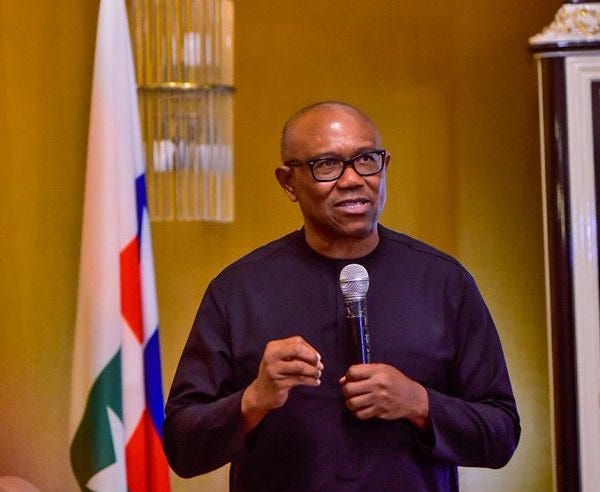
In February 2023, Nigerians marched to the polls to decide on whose shoulders the affairs of their government should rest. Many, especially debutant voters, followed the electoral process keenly and turned up at the booth with a degree of cheerfulness that signalled some sort of cautious optimism about the fortunes of the nation.
However, since the declaration of the “winners” across the cadres - executive and legislative - by the electoral umpire, INEC, the courts - of public opinion as well as the election tribunals - have been inundated with disputes and allegations of impropriety of the process and results.
Of the lot, the contention about the validity of the election that brought in the leader of the Executive, Bola Ahmed Tinubu, as the President has dominated the agenda table. And rightly so. The two leading opposition candidates, Alhaji Atiku Abubakar of the PDP and Mr Peter Obi of the Labour Party, both claim to have won the election outrightly by simple majority. They each argue, among other claims, that if all valid votes had been counted or if all invalid votes were duly discounted by INEC, they indeed won at the polls.
Many supporters of Mr Peter Obi, dubbed Obidients, could not fathom how their principal - who this article is about - and who had put in incredible mileage on his campaign tour across the country, galvanising previously dormant blocs, could have been deemed to have lost the elections, worse still placing second runner-up.
“Something illegal, irrational, unacceptable must have happened somewhere”, they claim.
Considering that Mr Peter Obi did not officially declare his intention to run for the Presidency until March 2022, 11 months to the election, and that his aspirations only started gathering serious momentum when he defected to the Labour Party in May 2022, his chances of actually winning the February 25 election may appear as some long shot to a person unfamiliar with how the lead up to the last elections panned out especially on social media.
The age-old assumption - that structure, time, and what-have-you would be needed to even threaten an upset against the traditional two-horses - would go on be seriously challenged, thanks to Obi’s candidacy and campaign strategy.
It was not the first time the idea of a formidable third-force candidacy has been mooted in Nigeria. In 2019, activist Omoyele Sowore of the African Action Congress (AAC) went on a Presidential campaign run that appeared to have genuinely catalysed a section of the youthful population, especially on social media. He raised approximately 157 million Naira as support funds for his campaign. While it wouldn’t have done magic considering the report of how much is actually needed to run for Presidency in Nigeria, the fact that random citizens believed in him enough to donate to his cause made his name standout and one to look out for at the end.
In that same cycle, former Deputy CBN Governor, Kingsley Moghalu, as well as popular motivational speaker, now SSA National Values and Social Justice to the President, Fela Durotoye, ran under the umbrellas of Young Progressive Party and A New Nigeria respectively. Unfortunately, the three candidates would go on to poll paltry 33,953; 21,886 and 16779 votes (from 27,324,583) respectively after failing to successfully coalesce into the much vaunted Presidential Aspirants Coming Together (PACT) group.
However, what happened in the lead up to the 2023 elections was nothing like Nigerians had ever seen from a “third-force candidate”. Leveraging on the strength of owned and earned media assets, social media virality and influencer credibility in the early days, Peter Obi defied the status-quo of underdog Presidential campaigns in Nigeria.
What started out as a few social media handles consistently tweeting about Obi’s candidacy, his soundbites and trackrecords rapidly grew into a presence that was enough to rattle opposition leaders and spokespersons; causing them to verbally dismiss the efforts of the Obidients - actions that in themselves acknowledged the much grounds the ‘new kids in the bloc’ were covering. In Nigerian social media linguo, the Obidients were seriously “putting preshur”.
On August 3 2022, former APC National Chairman, Adams Oshiomole, made the now infamous allusion to the Obi campaign as “four people tweeting in a room”. In his words, “We live in world where you can have 10 young men or women in one room, whether motivated or not motivated, and they can churn out one million stories using different names. You need to track them to find out that this one thing is being done in one room.”
It appeared that the pressure may indeed have been heating up in the APC camp as only two weeks and a few days later, on August 22 2022, another APC stalwart and spokesperson, Femi Fani Kayode, penned a lengthy ode to the drivers and commuters of the Obi campaign vehicle, in what he titled, “Who are these Obidients?”, acknowledging the potential danger their drive posed to his Principal’s candidacy. Whereas as of the time, a few inroads had been made with regards to physical rallies, marches and townhalls, the appeal of the Obi campaign began to spread like wildfire, especially among the youth demographic bloc on social media.
While it is very possible that Mr Oshiomole’s assumption may have been true at some point in the early days of the Obi campaign, the way and manner the earliest Obi campaigners had gone about the business had begun to yield real fruits as more and more names and faces with influence joined the train.
Within a few months, the campaign outgrew illusions and gathered real base as it became the cool thing to identify as Obidient. And one could argue, that the movement became so strong, online at least, that it appeared that everyone that mattered online was in the in-group. To not be in the in-group was to be anti-Nigerian progress, anti-fairness and anti-accountability. So the central messaging went. Every well-meaning Nigerian had to be on the side of the Obidients or, to use the exact linguo of the tribe, those who weren’t were “after our lives”.
As conversations around the elections dominated the cyberspace, Peter Obi and associated terms, like ObiDatti, Obidients, and the like stayed atop the trend table for days, leading to weeks and months. The candidate, himself, took to his Twitter handle, @PeterObi to weigh in on every trending national conversation, cashing in on his growing clout among the youth to advance his manifesto. Mr Peter Obi attended Twitter Spaces as much as he graced almost every invite he had physically.
And the result of that was plenty more owned media assets to saturate social media with. A careful examination appeared to show that though there was a core of handles who led his campaign charge on Twitter. There was @Jack_ng01 and @Morris_Monye. If the assets were not distributed by any of those, it was posted by @firstladyship, @GeneralOluchi or a certain @MissPearls who were ever ready to clapback against any opposition with facts or venom. @Tutsy22 and @YarKafanchan were always on hand to amplify content or create some of theirs, just as @BOGbadams and @GRVLagos pulled their weight as political voices. It helped that a few technocrats also weighed in along the line, including the likes of @Asemota and @DrChife.
And if there was a need to shut down conversations, there were as many accounts with usernames of Northern and South Western origins that rose to prominence which could do the job. Although, there has been a lengthy argument about the credibility of these accounts with checks on some of them revealing that some were actually catfish accounts. The argument on whether they were deliberately created to create an assumption of broad acceptance of the candidate among the public will continue to linger. As politics go in Nigeria, however, you can never be sure who did what and to what end. But what we can be sure of though is that what began with only a few people truly catalysed into something bigger than them.
As the stock of the former Anambra Governor rose, the persona of the man, for all his wealth and profile, was further furnished to come across as accessible and down to earth, by his image makers. Among his many forays, his most stellar shows appeared to have come from his visit to the Experience, the Lord’s Chosen Charismatic Revival Ministry, his frequent interviews with Arise TV as well as snippets from his previous appearances at the Platform, Nigeria. His blend of soft-spokenness and apparent convictions in his ideas also endeared him to not a few.
By October, when pictures and videos of impressive turn outs at the many “1 million marches” as well as Obi’s campaigns in the most-remote Nigerian towns hit the internet, it was fair enough to assume that, beyond everything Obi said and appeared to be, the manner with which his campaign was delivered was about enough to entrench the Fear of Missing Out (FOMO), arguably positively, on people who were not publicly aligned as party people.
When other popular government critics and previous members of different parties also began to defect to or appear to be sympathetic to the cause of the Labour Party (for examples, David Hundeyin, Kenneth Okonkwo and Naja'atu Bala Muhammad), as against the baggaged candidate of the APC, it could be argued that there was a certain sense of knowledge of right and wrong as well as justice and wisdom that appearing to belong to the Obidient tribe conferred on members, and this could have made everyone following the campaigns to want to belong - whether or not they realistically had a PVC or the intention to vote the Labour Party.
A strong digital army was birthed. An army that would amplify everything Peter Obi and shut down every opposition campaign, with facts and sometimes without - but with such sheer fierce noise that was enough to make opposition voices cowered and rather silent or appear to be non-aligned. It could be argued that such was the case of the likes of Ogbeni Dipo who would only after the election publicly declare his allegiance for the APC. The fear of the Obidient army was the beginning of reflection on whether to make that pro-government post or not.
By the time election analysts and institutions began to release predictive polls and projections, they seemed to predict, for the most part, that in the event of a high turnout, Peter Obi would win the election. See Stears and Bloomberg’s analyses. However, some claimed that a low voter turnout could have resulted in a rerun, as predicted by Dataphyte or led to a Tinubu win.
In the middle of this, a concern that began to emerge was the number of people who appeared undecided, or were not willing to show their hands as to who they would most likely be casting their ballot for, as reported by ANAP polls. Thus, a few people began to prop up the possibility of a silent majority swinging the tides of the results - a scenario that people sympathetic to the APC and Tinubu were too happy to lap on.
When after the elections, Tinubu was declared winner, the idea of a silent majority was a convenient default defence for the APC faithful as to why they won the election against a divided opposition. While the opposition were left to rue their chances, and to allege impropriety in the process and results of the election, the LP-Obi faction especially could not accept that they had not been rigged out given the quantum of their campaign online and subsequently in the nooks and crannies of the country.
However, their opposition, the APC, PDP, other parties as well as some unaligned analysts have argued that the Obi campaign may have had an exagerrated perception of the work they did and the results they got, a scenario that’s consistent with the illusory truth effect.
For years, media scholars and practitioners have debated if perception is reality. And while there have been varying opinions, they all seem to agree that communication is central to image making. Thus, brands - corporate and personal, especially politically exposed persons - are beginning to place emphasis on the impact of communication for stakeholder management and public relations.
What that simply means is that the mental impression a person has of something would define how they see it, regardless of the truth. In other words, while there may be a real truth, people only believe the truth to be what they perceive to be the truth, and usually, this is influenced by what they have been exposed to in terms of the image of the persons or brands involved.
With the advent of digital publishing platforms and social media applications challenging traditional media, politicians now understand that how they use their new media to manipulate exposure and perception among the people matters a lot.
While in the recent past, political communication was majorly through traditional media like television and radio, the turn of the century has seen the emergence of social media as an important new player, transforming mass media campaigns into “hypermedia campaigns.”
While at the start of the Obi campaign, there may really have been just the figurative “four people tweeting from a room,” the manner and consistency with which the social media campaign strategy was executed was good enough to spark belief in many other people and translate to real votes. Thus, defying any argument that hashtag activism cannot lead to real life consequences.
Using hashtags like #ObiDatti2023, #Obidients, and #1MillionMarch4PeterObi as well as new media communication tools like Twitter spaces, the campaign managers translated online support to on-the-ground activities, volunteering to go door-to-door to spread the party’s message. Leveraging the power of social media, the party also called for donations which it used to manage the publicity gap between the two established parties.
And what was the outcome?
The Labour Party which had polled just over 5,000 votes in the 2019 presidential elections amassed 6.1 million votes this time — falling short of second-placed PDP by just about 800,000 votes.
The Peter Obi example highlights how effective social media campaigns and/or illusive truth strategy can translate into real-world support for political candidates. Or at the very least, swing undecided media users - who may struggle to deal with FOMO that comes from repeated exposure - to comradeship.
But What Exactly is the Illusive Truth Effect?
While it is true that political campaigns are increasingly leveraging the power of new media to connect with voters and build support because of the evident benefits, a high level of positive interactions and engagement on a candidate's digital content could create an exaggerated perception of their popularity, which may go on to have positive or negative effects on the outcome depending on what is done in the real life with the gains of social media. This is the illusive truth effect.
Illusion of support may grow because of bandwagon effect. Bandwagon effect is a psychological phenomenon where people tend to support something or someone simply because it appears to be popular. This conformity is driven by the desire to belong, a fear of missing out and the pressure to make decisions perceived as socially acceptable. The effect is amplified in situations where people perceive an overwhelming majority supporting a particular option.
Some researchers have argued that an individual’s attitudes and behaviours are shaped by their perceptions of the choices of others. They say that this is true when people decide what technology to adopt and when, what song to listen to or what causes to support.
In new media driven political communication, the illusion of online support is fueled by engagement metrics such as likes, shares, reposts, comments, and followers on social media platforms and infers that as individuals witness high engagement rates on a candidate's digital content, they may perceive the candidate as credible, popular, and deserving of their support. A scenario that is consistent with the Obi campaign. The illusion of support can arise due to the visibility of positive interactions, even if those interactions are driven by a relatively small group of fervent supporters.
McPherson et al. contends that social media interactions may not necessarily represent the overall mood of the public as information shared on the feed of socially connected individuals tend to be similar and this possibility could mean that people are exposed to a biased sample of the population, giving rise to “selective exposure” that make people have delusions of grandeur. Or leading to an echo chamber.
The combination of the bandwagon effect and the illusion of online support creates a feedback loop. Thus, as more individuals witness high engagement on a candidate's online content, they are more likely to perceive the candidate as popular, leading sometimes to increased real-world support, as was the case with Nigeria’s Peter Obi, America’s Barack Obama and France’s Emmanuel Macron. This, in turn, attracts more online engagement, further solidifying the illusion and encouraging additional support.
However, this may not always translate to real life values. As is the case with the Sowore 2019 Presidential Campaign in Nigeria. Although the AAC candidate enjoyed some level of social media goodwill, he was only able to garner about 33,000 votes out of 27 million total votes cast, finishing sixth in the elections.
What this means, therefore, is that modern political campaigns must strategically navigate the interplay between online and offline support. By strategically curating content to foster the illusion of online support, campaigns can tap into the bandwagon effect to increase actual voter backing. Campaign managers must put in place actual offline activities to leverage the "momentum" created by the illusion to sway undecided voters!
We have unpacked a lot today and here’s me thanking you for sitting through my lengthy analysis. If you enjoyed this post, please do well to share and recommend this newsletter to other people.
I know you’re waiting to hear about what has been piquing my interests in the past few weeks that I have been away. Well, here it is. I have put on repeat Asake’s Sunshine and have been taking time to binge on compilations of Eden Hazard’s brilliance during his playing days. What a player he was!
One more thing, I love feedback. So I will be happy to hear any comments, questions, suggestions, or disagreements you may have with any of the opinions I have expressed in today’s letter. Enjoy your weekend, folks!